
Ossigeno Annual Report 2025 / Part 4 – Italy’s Failures over the Rule of Law
Questo articolo è disponibile anche in:

Annual Report of the Observatory on Threats to Journalists and News Concealed in Italy Through Violence and Abuse
OSSIGENO, March 24, 2026 – Below is the text of the dossier delivered on January 20th 2026, by Ossigeno to European Commission officials preparing the Italy chapter of the 2026 EU Rule of Law Report.
All the problems affecting the media sector and pluralism listed in the European Commission’s Rule of Law Report published in July 2025 continue to manifest themselves and have negative impacts on press freedom and on the pluralism of information. Some problems have worsened. New problems have emerged, resulting in serious violations of the right to information, as demonstrated by Ossigeno per l’Informazione‘s monitoring, which described the phenomenon in its qualitative and quantitative dimensions, documented hundreds of incidents, and analysed the resulting data. Especially serious violations have increased. SLAPPs, threats, and attacks against newspapers and journalists have become more numerous and frequent. SLAPPs have become ubiquitous imposing on those affected anguish and considerable legal costs which are almost never been reimbursed, not even after acquittals. Faced with this situation, which particularly challenges freelancers, local reporters, and journalists without legal protection from the publisher, Ossigeno has established a free legal emergency service for threatened individuals who can demonstrate they have acted in good faith and in compliance with the ethical rules of journalism.
31% MORE JOURNALISTS UNDER THREATENED – Active monitoring conducted by the Ossigeno per’Informazione observatory has identified 677 journalists threatened in Italy in 2025, a 31% increase from the previous year, when 516 were threatened. Violent intimidation targeted 83.7% of the 677 journalists threatened (+13.4%). The intimidations took place throughout Italy. The regions with the highest number of threatened journalists are Piedmont, Lombardy, Lazio, and Sicily. Ossigeno, an NGO operating since 2008 with the support of the Order of Journalists and the patronage of the FNSI (the unitary trade union of Italian journalists), has documented, since 2006, over eight thousand threats in Italy against newspapers, bloggers, and human rights defenders. It publishes the names of those threatened and the circumstances under which they were threatened on the website ossigeno.info. Seehttps://www.ossigeno.info/ossigeno-677-giornalisti-minacciati-nel-2025-in-italia-31/
MORE THREATENED, FEWER FORMAL COMPLAINTS – Monitoring shows that only one in six threatened journalists formally reports the threats to the authorities. The figure is derived from a comparison with data from the Ministry of the Interior’s observation centre, which only takes into account formal reports to law enforcement. In the first half of 2025, it reported 81 journalists threatened (see https://www.odg.it/atti-intimidatori-ai-giornalisti-il-report-criminalpol-con-i-dati-del-primo-semestre-2025/63146). In the same period, Ossigeno documented 361, reporting a 78% increase compared to 2024 (see https://odg.roma.it/giornalisti-minacciati-78-rispetto-al-2024-cresce-la-violenza-anche-politica/ ).
THREE EXTREMELY SERIOUS INDICES – Three of the most significant incidents were:
– the bombing in Rome at the home of RAI journalist Sigfrido Ranucci, who was already under law enforcement protection;
– the raid on the Turin editorial office of the daily newspaper La Stampa, an unprecedented episode of collective intimidation
– the intimidation of Giorgia Venturini, a Milanese reporter investigating the Mafia, who found the severed head of a goat in front of the entrance to her home.
The incidents in Rome and Turin demonstrated that the law enforcement protection for these threatened journalists was inadequate and insufficient.
GROWTH OF SLAPPS – Spurious civil and criminal actions classified as SLAPPs continued to target journalists with great frequency. Monitoring confirms the growing trend (up 8% annually) reported in 2016 with the statistics provided by the Ministry of Justice (the latest published). Those data reported 6,000 new legal actions each year. Nine out of ten of them resulted in the acquittal of the accused, demonstrating that the charges were unfounded. The 93 SLAPPs in 2005 that Ossigeno documented publicly and in detail confirm the worrying trend of the phenomenon already observed in the previous three years (see https://www.ossigeno.info/dossier-ossigeno-le-slapp-in-italia-hanno-colpito-290-giornalisti-nel-2022-2024/ ).
HALF OF THE ATTACKS FROM THE PUBLIC SECTOR – These highlight the lack of adequate measures to prevent and sanction these abuses, which, according to Ossigeno statistics, in 2025 were committed in 52% of cases by public figures and institutions and approximately 15% by entrepreneurs and private companies. In Italy, cross-border SLAPPs are very few. EU Directive 1069 will have little impact since it will apply exclusively to cross-border civil cases, as decided by Parliament and confirmed by the Government (see https://www.ossidoinfo/meloni-la-direttiva-anti-slapp-si-applica-solo-a-cause-trans-frontaliere/ ).
THREE PARTICULARLY SIGNIFICANT SLAPPS:
-
a company requested €2 million from two environmentalists from Pesaro;
-
a company from Faenza requested €50,000 from freelance journalist Linda Maggiori;
-
An entrepreneur demanded €200,000 from journalist Carlo Ruocco of Sarzana.
RESPONSES TO THE RECOMMENDATIONS OF THE 2025 REPORT
None of the issues raised by the Recommendations have seen any positive progress. The previous year’s results were virtually identical. In Italy, the 2025 Rule of Law Report was known only to media experts, but not to the general public. The Italian media ignored it, as did the Italian parliament, the government, and other public institutions in the sector, which neither discussed it nor commented on it. They are not known to have taken any steps to publicly discuss the Recommendations and respond to the issues related to Italy.
PROCEDURES FOR THE APPOINTMENT OF THE HEAD AND MEMBERS OF THE MEDIA REGULATORY AUTHORITIES
The four commissioners of the Italian Communications Regulatory Authority (AGCOM) are elected half by the Chamber of Deputies and half by the Senate of the Republic, while the President is proposed directly by the Prime Minister in agreement with the Minister of Economic Development (as established by the Maccanico Law). After these choices, the final appointments are endorsed by the President of the Republic. The body remains in office for seven years. Due to the criteria for appointing the Authority’s members, AGCOM has been described as only “semi-independent” since an “independent administrative authority” should be neither hierarchically nor politically subordinate to the Ministries, in order not to be characterised by conflicts of interest of a political or economic nature. https://it.wikipedia.org/wiki/Autorità_per_le_garanzie_nelle_comunicazioni
PRESS COUNCILS AND OTHER SELF-REGULATORY BODIES
These bodies do not exist in Italy and there are no plans to establish them. Since 2012, citizen complaints regarding violations of journalists’ ethical obligations have been adjudicated by national and local disciplinary councils, composed of journalists. The councils can apply sanctions ranging from warnings, censure, suspension, up to dismissal. Seehttps://www.odg.it/il-consiglio-di-disciplina-nazionale. The publication of decisions by Journalists’ Disciplinary Councils is governed by the principle of transparency balanced against the protection of personal data. Decisions that result in sanctions are generally published (often anonymised or with only the surname indicated), while decisions that do not result in sanctions or informal warnings may be more discreetly published.
TRANSPARENCY AND CONCENTRATION OF MEDIA OWNERSHIP
In 2023, Italy ranked fourth-to-last among EU countries in terms of transparency of ownership of major media outlets, according to the Euromedia Ownership Monitor (EurOMo-27). According to this study, the factors negatively impacting media transparency in Italy stem primarily from the Chinese-box structure, with multiple companies nested within a large macro-group, that characterises the country’s media organisations. This structure prevents clear and linear connections through to the top management. In the years since, the situation has not improved. Hopes rest on the implementation of the EMFA (European Media Freedom Act), scheduled for 2026.
There are no rules requiring full transparency of media ownership. It is hoped that these will be introduced once the EMFA is implemented. The Government has committed to doing so by the deadline, amending some existing rules.
RULES FOR THE PROTECTION OF JOURNALISTS
There are no codified rules to guarantee the protection and safety of journalists who are threatened and exposed to personal risk due to their reporting. Anyone who believes they are in danger must contact law enforcement who will take their concerns into account as they would any other citizen. Many journalists openly state that they have given up reporting threats, intimidation, and assaults to law enforcement because they are convinced that such reports do not yield meaningful results. The number of those who do not report has increased in recent years. However, in some cases, law enforcement itself has notified journalists of dangerous situations resulting from police investigations and information and offered them protection. Cases where the risk appears more serious and imminent are assessed by the Provincial Committees for Public Order and Safety, chaired by the Prefect. These bodies decide whether to provide journalists in danger with an armed escort or other protective measures that require fewer law enforcement resources. In 2025, 30 journalists were under armed escort. Information on the number of those protected by other protection services was not provided. In recent years, armed escort services have proven reliable and effective.
JOURNALIST SAFETY DURING PROTESTS
Law enforcement generally respects the work of journalists during protests but they do so by following informal rules that are not codified and which, in some cases, have proven ineffective in preventing incidents. Ossigeno‘s calls for an agreed code of conduct for journalists and the police were not taken up even after the serious incident in Genoa in 2019, in which journalist Stefano Origone was beaten by officers engaged in public order during a protest. The criminal proceedings to punish those officers responsible were not straightforward. An initial ruling handed down very light sentences, inadequate for the personal injuries caused. After the Supreme Court overturned the ruling, a new trial was held in 2025, and four police officers were sentenced to one year in prison. See https://www.ossidono.info/cassazione-definitiva-la-condanna-per-gli-agenti-che-picchiarono-stefano-origone/
ACCESS TO PUBLIC DOCUMENTS
Procedures for accessing public documents exist but they can be time-consuming and expensive.
MEASURES TO COMBAT THE ABUSE OF SLAPPS AND DEFAMATION PROCEEDINGS
In Italy, there are no effective safeguards to protect journalists from SLAPPs and other civil and criminal actions (lawsuits) filed with accusations of libel. These legal proceedings are almost always unfounded or false, yet have a punitive effect. The Italian Criminal Code requires a trial for every formal complaint of a crime (an obligation to prosecute). There are no procedures for dismissing at the outset clearly vexatious lawsuits (early dismissal). A judge can dismiss a lawsuit only by first conducting a trial. The same applies to civil cases. This requirement to initiate legal proceedings makes SLAPPs a highly useful, effective, and frequently used tool for those seeking to hinder newspapers and journalists who publish unwelcome news. It is a powerful tool for intimidating journalists, even with false or specious accusations, and it also effectively punishes even those who are ultimately acquitted since journalists almost always have to pay their own legal costs for defending themselves in court, even if they are acquitted. This unfair regime is particularly challenging for freelancers and journalists at small newspapers and fuels self-censorship. There are some provisions in the code which allow for punishment for those who abuse the process and make false accusations but these provisions are rarely applied. Bill S.466 aims to address the legislative problem of the abuse of defamation lawsuits and the protection of journalists’ professional secrecy and their sources. This bill proposes measures supported by the government majority, but are deemed insufficient and misguided by Ossigeno and a broad political spectrum. In 2025, the bill did not continue through its parliamentary process. Its discussion had already been halted at the end of 2024 at the request of the government (see https://www.ossigeno.info/querele-il-ddl-diffamazione-in-marcia-verso-il-binario-morto/). In December 2025, a parliamentary debate confirmed that on these issues, even after recent serious incidents of intimidation and threats against newspapers and journalists, the Government will maintain the minimalist approach of recent years, a policy that has not produced any concrete countermeasures (see https://www.ossigeno.info/diffamazione-anti-slapp-emfa-nessuna-misura-a-effetto-immediato-in-vista/).
INCREASE IN WIRETAPPING
Various incidents have shown that in 2025, the abuse of wiretapping on the phones and computers of journalists and human rights defenders has spread, some carried out without authorisation from the judiciary. The most serious cases involved journalists Francesco Cancellato and Ciro Pellegrino, both of the online newspaper Fanpage, and several NGO activists involved in the rescue at sea of migrants. The wiretaps were conducted using the Paragon spyware, released by the Israeli company Graphite only to government officials, with the restriction to use it only for national security reasons and never against journalists. The government has denied ordering these wiretaps and has denied any responsibility. However, it has not explained what actually happened. Opposition Senator Matteo Renzi, a former prime minister, accused the government of spying on journalists with “preventive wiretaps,” which by law should be used only for national security reasons. Renzi explained what, in his opinion, actually happens: at the request of the prime minister or the authority delegated by him, with the authorisation of a judge, preventive wiretaps are ordered for national security reasons. In 2025, political activists dealing with immigration were wire-tapped , as well as a priest and, most seriously from an institutional point of view, the chief editor of a newspaper who investigated the youth wing of the governing Brothers of Italy party (Matteo Renzi on March 23rd 2025 on La7 TV channel).
Read the other parts of the 2025 Report
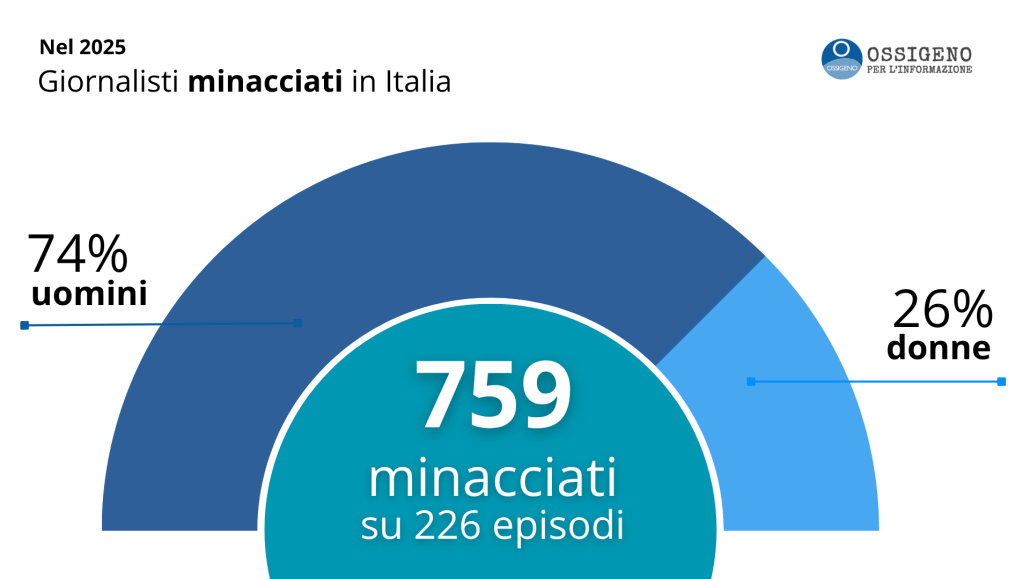
Part 1 – 759 journalists threatened in Italy. How? By whom?
Part 2 – A dark year with some light on the horizon – Trends and prospects
Part 3 – Legal assistance and the mirage of anti-SLAPP measures – The Ossigeno Legal Aid Desk
Ossigeno 2025 Report was edited by Grazia Pia Attolini, Laura Turriziani, and Alberto Spampinato


Leave a Reply
Want to join the discussion?Feel free to contribute!