
Ossigeno Annual Report 2025/ Part 2 – A dark year but with some light on the horizon
Questo articolo è disponibile anche in:

From the Observatory on threats to journalists and news obscured in Italy due to violence and abuse:, edited by Grazia Pia Attolini, Laura Turriziani and Alberto Spampinato
OSSIGENO March 24th 2025 – In Italy, 2025 was a dark year for press freedom and the safety of journalists, bloggers, and activists committed to disseminating ideas, opinions, and information of public interest. A year worse than previous ones, which were already bad. Fortunately, at the end of the year, a ray of sunshine gave hope for improvement.
The alarm from the Order of Journalists
The sun shone when the National Order of Journalists, with an unprecedented political initiative, signalled a red alert on the ongoing escalation of threats against and intimidation of journalists. The Order has called on institutions, political parties, editorial, and professional bodies in the sector to jointly reflect on how to stop violence and abuse, restore full freedom of information, and resolve in a dignified way the profession’s problems.
The Order demonstrated the gravity of the situation in a dossier that, in addition to describing the problem, cites data from the Ossigeno per l’Informazione observatory on the number of journalists under threat in Italy, figures that show a sharp increase compared to the previous year. The Order of Journalists presented the dossier to the Italian President Sergio Mattarella, the presidents of the Chambers of Deputies, the Italian Regulatory Authority (AGCOM), and others. The initiative began with a public conference in Palazzo Montecitorio where the lower chamber of the parliament sits. “We journalists are also experiencing a difficult time in Italy, “ said Carlo Bartoli, president of the Order of Journalists, at the conference, listing the profession’s many problems and placing threats at the top of the list.
This ray of sun is a source of hope. But it does not remove the clouds that had accumulated over the safety of journalists, as Ossigeno has shown. The most telling fact is this: the situation has deteriorated since the early months of 2025 and whilst there have been very serious attacks against journalists no countermeasures have been adopted.
The numerical and qualitative assessment
The threats have continued unabated and have manifested themselves in increasingly serious incidents: violent acts, unfounded and specious legal actions, arbitrary discrimination. The list of those who have suffered abuse and violence is long. It can be consulted along with the list of names of those threatened. (Read here)
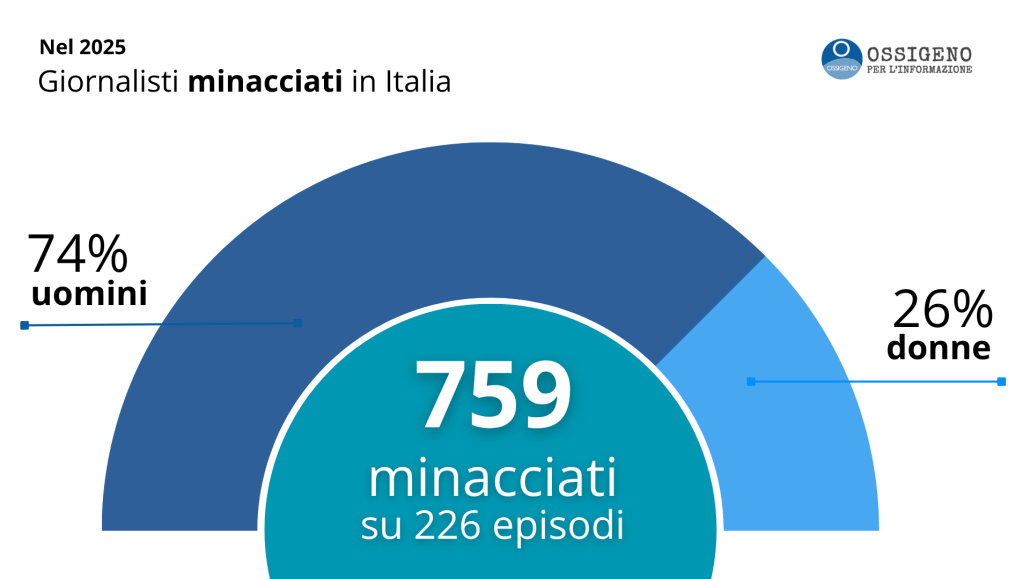
Between January and June, the number of threatened journalists increased by 78%. At the end of the year, the increase stood at 47%, with 759 threatened compared to 516 in 2024. The situation has also worsened qualitatively since the percentages of the most violent acts have increased: assaults (+7%) and physical damage (+19%). Intimidation from the political and institutional world has also increased, as have intimidation against groups of journalists or entire editorial offices. Accusations of violations of ethical standards, directed, in an exploitive way, against journalists, have also increased.
This is not good news for Italy, a country sadly known for the high number of journalists under police escort, for the unpunished violations of the right to information, for its anachronistic laws and punitive procedures against journalists, and for its lowly position among European countries (in 2025, Reporters Without Borders demoted it from 46th to 49th place) regarding press freedom and the right to expression, despite the numerous calls to address this situation with adequate measures and appropriate countermeasures.
Old and New Forms of Intimidation
In 2025, unprecedented incidents of electronic surveillance and illicit espionage of investigative journalists using highly invasive software were exposed in Italy. Suspicions have arisen that preventive interceptions by the intelligence services for national security reasons are being abused for political purposes. Active and independent monitoring by Ossigeno per l’Informazione has documented the evolution of this phenomenon and identified some very marked negative trends. This annual Report documents them.
Unfounded lawsuits, frivolous civil defamation lawsuits, and SLAPPs have become widespread. These and other specious legal actions have forced people who had legitimately published news, ideas, or opinions to incur considerable legal defence costs, expenses that have not been reimbursed in cases of acquittal. Many freelancers, local reporters, and journalists work without legal protection from publishers. They are the most exposed to these legal actions and are the most damaged.
The bill to reduce the abuse of defamation lawsuits, introduced in the Italian Parliament at the beginning of the 2023 legislature (bill S.466), was not approved. The text has lain with the Senate Justice Committee since spring 2024.
The new European Union rules providing more favourable conditions for journalists and the exercise of freedom of expression have not met with favourable reception. The government has rejected the request to apply the provisions of the Anti-SLAPP Directive to non-cross-border cases, i.e., to most Italian cases of SLAPPs (see here)
Furthermore, the entry into force of the European Media Freedom Act has been postponed until the last possible moment in order for the government to study ways to blunt its positive effects on the transparency of editorial ownership and the governance of public service broadcasting. See here.
The Unheeded Recommendations
The “recommendations” made to Italy in July 2025 by the European Commission in its Report on the Application of Rule of Law Standards were not adopted by the Government.
These recommendations call for 1) ensuring adequate funding for public service media to fulfil their mandate and guarantee their independence; 2) continuing the current legislative process on the draft reform of defamation, professional secrecy, and the protection of journalists’ sources, “while avoiding any risk of negative impacts on press freedom and ensuring that it takes into account European standards on the protection of journalists.” The 2024 EU Rule of Law Report had made the same recommendations.
The issue of threats has not received the attention and care it deserved, based on the publicly documented violations that have occurred.
The Silence of the Media and the Perception of Journalists
The media and the political world in general have paid little attention to the intimidation of journalists. Any attention has been sporadic, driven by a few high-profile news stories. Silence has shrouded the remainder and hidden the problem from public opinion. Few members of the public have realised the vast scope of selective censorship produced by threats. Few have sensed that this is an on-going and urgent social problem.
A Taboo Subject
Legal threats and intimidation through lawsuits,, SLAPPs, and spurious and intimidating warnings are a taboo subject for newspapers and journalists. The prevailing idea is that it’s better not to talk about them. Many are convinced that a journalist is not exposed to threats and frivolous lawsuits if he or she works correctly and prudently. This is not the case. And this is demonstrated by thousands of real-life incidents reported by Ossigeno. In Italy, most defamation lawsuits are specious, unfounded, and reckless. Official statistics on the results of defamation trials confirm this. It is not true that simply being cautious is sufficient. Yet many hold this opinion and this explains why many threatened journalists remain isolated, failing to receive the strong and active support of their colleagues even if they have not violated their ethical obligations.
Who is most at risk of being sued?
Denial of the existence of the problem is a very common attitude and is explained by misinformation and, in the case of journalists, by the fact that journalists exposed to the threat of reckless lawsuits constitute a minority within their profession. Those most at risk of being sued are those journalists who actually work on news and current affairs reports, those who are first to gather the news and who contact sources. Among them, external collaborators, freelancers, and editors of small newspapers are at the greatest risk and enjoy the least protection. In the event of a lawsuit and with a few exceptions, the publisher will not cover lawyer fees, legal costs, any compensation, or financial settlements. The affected journalists have to deal with these matters on their own. Hence frivolous lawsuits are very restrictive for them because they weigh heavily on their personal finances. A determined plaintiff or someone demanding intimidating compensation can even force these journalists to change their occupation. This is how it is, and will continue to be, until a way is found to provide solidarity to all journalists, and until the law—as is right and as Ossigeno proposes—obliges the publisher to bear these costs for lawsuits brought against anyone who publishes information in their newspaper. Until then, it will be even more necessary to introduce severe penalties against those who abuse legal procedure for the purposes of intimidation and blackmail.
The selection choice of which statistics to cite
These and other problems do not make it to the public eye because there are always various ways to downplay them. The main one is the media silence already mentioned. Another is highlighting only a portion of the news, so as to make the situation appear less alarming. This can be done, for example, by citing only a selective portion of the available data on the number of journalists threatened in Italy. Along with its own data, Ossigeno always provides data from other monitoring centres that observe the same phenomenon and publish their own data. These other observatories report fewer journalists under threat than Ossigeno does. Many prefer to publish only the statistics from these other centres, presenting them as if they were the only ones available, almost always without disclosing the criteria used. Thus, for example, reports are published that report five, ten, or fifty times fewer journalists under threat than Ossigeno. Besides confusing those who want to be informed, this provides an à la carte menu for those who want to downplay what is really happening. Therefore, Ossigeno urges those publishing data from the Italian Ministry of the Interior, the MFRR (Media Freedom Rapid Response, funded by the European Commission), the Council of Europe Platform, and Reporters Without Borders to always indicate the monitoring criteria of the source cited and to compare its data with those of Ossigeno and other observation centres.
The Great Inattention Ended by a Bomb
The fact that this has not happened speaks volumes about the lack of and inconsistent attention to the problem. This is also reflected in the delay with which the world has noticed the further escalation of intimidation particularly violent ones against Italian journalists,. This trend was evident from the beginning of this year and online. On social media and in the newsletter on the website ossigeno.info there were numerous reports of incidents attesting to intimidation since the beginning of the year. But it only began to be more widely discussed in October.
Public attention was drawn to it after the serious bombing of the investigative journalist Sigfrido Ranucci. It grew after Ossigeno published its updated data on October 28th 2025, reporting that in the first half of the year, the number of journalists threatened in Italy had increased by 78%.
Two highly exposed but poorly protected targets
Then, a month later, attention was rekindled by the Fascist raid on the editorial offices of La Stampa in Turin. This episode demonstrably unprecedented, due to the nature of the group attack and the decision to target an entire newspaper. The media covered it extensively, but failed to thoroughly reconstruct the sequence of events. The media failed to mention that the newspaper had been targeted by opponents for over a month, that some editors were threatened personally by name, and that these journalists and this newspaper were not adequately protected. These circumstances were disclosed only by Ossigeno. Moreover, the attack on Sigfrido Ranucci was also reported by the media without highlighting that he was not adequately protected, despite already being under a form of police escort, and despite being the most well-known journalist under threat. That he was indeed not adequately protected became clear a few days after the attack, when the Ministry of the Interior reinforced his protective escort, raising it to a higher level of risk.
The flash in the pan of emotional attention
The Ranucci bombing and the attack on La Stampa marked the highest level of media attention for violence against journalists, although with these limitations. Furthermore, this attention proved to be primarily emotional and faded as quickly as it had flared up. This has happened many times in Italy following particularly serious acts of violence against journalists. It is not a new phenomenon. It had already happened in 2007 after the attack on journalist Lirio Abbate, which sparked a general mobilisation of Italian journalists, culminating in a solidarity march with him in Palermo. It happened again in 2019 after Daniele Piervincenzi’s bloodied face appeared in all the newspapers. It has happened many times and has taught us that these flashes, these flashes in the pan that warm the spirits, do not mobilise consciences.
The right to inform and to be informed
To mobilise consciences, first of all, citizens need to be systematically informed of the threats and intimidation targeting newspapers and journalists. The public needs to delve deeper into these events to familiarise everyone with the basic principles of the right to inform and to be informed. Schools should teach the right to inform and to be informed and what constitutes information of public interest. Everyone should know that the right to privacy and the right to defend one’s reputation applying to private citizens, is greatly attenuated for politicians and other public figures. Everyone should know that journalists have the right and duty to seek out and report news of public interest even if it entails prying into some individual’s affairs, even if some may dislike it. If the rules of information were as well-known as the rules of football, there would be more information and fewer unpunished violations.
In Italy, national and local media should help spread this awareness. They should not limit themselves to reporting a few incidents, usually the extremely serious ones that are difficult to ignore or those involving well-known public figures. According to a rough estimate, media outlets report one incident out of every hundred made public by ossigeno.info. Furthermore, with a few rare exceptions, the media does not routinely publish statistics on the number of journalists threatened in Italy, as if these were not news of public interest.
It is difficult to say why all this happens. Newspaper publishers and editors do not offer explanations, but they adhere to this practice, ignoring news of undoubted interest to their readersnews that would help raise awareness of the problem and news that would help threatened journalists break their isolation and promote solidarity with them.
Not contextualising is another way of minimising.
Reporting the news about threats to a journalist without contextualising it, without mentioning that other journalists in the same city, in the same region, in Italy, have been similarly threatened, is not only an example of bad journalism, it is a way of manipulating information, minimising its impact and its effect on readers and listeners. This happens regularly in Italy, even when reporting sensational incidents like the October 2025 attack on Sigfrido Ranucci. It is significant that after the bomb exploded in front of his home, while everyone was talking only about his case, Ranucci made the point that he wasn’t the only journalist under threat in Italy, and demonstrated it with facts, repeatedly citing Ossigeno‘s data on the 516 journalists threatened in Italy in 2024.
The Responsibility of Newspapers and Journalists
The media silence is certainly also the responsibility of journalists themselves . They are the ones who make newspapers. Why does each one of them not take action to ensure these issues are discussed at least in their own newspapers? One possible explanation is that the journalists also have a low perception of the problem. It also linked to the fact that the journalists truly and most heavily exposed to threats, intimidation, and lawsuits are a minority of the profession. They are reporters and investigative journalists. Despite the important role they play, they do not have their own dedicated representative body.
Unfortunately, in this situation, the responsibility for speaking out about the threats falls entirely on those threatened, on the victims, for whom this entails a further risk of retaliation.
It is a major Italian problem
The restriction of freedom of expression through threats, intimidation, and legal abuse has been clearly shown to be a major Italian problem. For many years, it has negatively impacted the free conduct of public life. It restricts the circulation of ideas, opinions, and information. In addition to journalists, bloggers, and targeted activists, it harms countless others and ultimately civil cohesion. It should be discussed widely, more frequently and a solution sought. Instead, the issue is absent from public debate. This dark evil claims ever more victims and reduces the space for information and public participation, but no action is being taken to eradicate it as it should.
A problem still without a name
An awareness of all this needs to be raised, starting with the fact that this major social problem, unlike others (poverty, racism, the environment, etc.), doesn’t even have a proper name; it has not yet been able to acquire one. This speaks volumes about how rejected and neglected this problem is, even though it continually generates new forms of censorship, threats, intimidation, and specious legal actions that repress uncomfortable ideas and opinions, obscuring important information and the most inconvenient news for those in power. Information that everyone has a right to know.
Restrictions on freedom of expression illegally enact a censorship that the Italian Constitution law forbids, since any type of censorship violates the fundamental right to inform others and receive information. Among other things, these violations, by obscuring part of the truth, pave the way for propaganda and misleading narratives that restrict the field of knowledge on which citizens can base their choices.
Journalists, civil rights defenders, activists, bloggers, environmentalists, satirists, authors and film-makers are those most directly affected. Ossigeno per l’informazione has recorded 8,665 cases from 2006 to today, verified them, and publicised the individual incidents. It has explicitly documented each incident.
The contribution of statistics from the Ministry of Justice.
In 2025, Ossigeno identified over eight thousand people under threat, an unimaginable number and yet it is a figure that only shows the tip of the iceberg. How large is the hidden portion? To estimate that at least five thousand victims per year need to be added to the 8,665. . According to data from the Italian Ministry of Justice, five thousand journalists are put on trial each year on libel charges and are acquitted because the charges against them are found to be specious and unfounded. Calculating the total over 19 years produces a truly staggering number.
This is the situation in Italy. There is a veritable massacre of freedom of expression and press freedom. Yet is is hidden by a deafening silence and indifference.
In 2025, only the bomb that exploded on the evening of October 16th at the entrance to the home of the Reportprogramme journalist Sigfrido Ranucci and then, on November 28th the unprecedented attack on the editorial offices of the daily newspaper La Stampa managed to rupture the silence (which was also media silence), albeit temporarily. Even on these occasions, the event could be seen for what it really was, a failure to state clearly that these are just two of the many unacceptable intimidations directed at journalists in Italy who do their job well and courageously, bringing to light proven facts and circumstances of public interest—facts and circumstances that some individuals actively conceal for personal gain. This needs to be addressed more clearly, stating that the threats against these journalists are unacceptable violations of a fundamental right, without insinuating that they are somehow partially guilty and deserve forgiveness. They are not guilty, but an inverted judgement of Solomon prevails. An opportunity is missed to point out that the UN, the European Commission, the OSCE, and other authoritative international organisations are urging Italy to better protect journalists and to amend the archaic Italian defamation law, since it claims thousands of innocent victims every year and, simply by providing for prison sentences for the guilty, has an intimidating effect on the entire journalist population. The criminal law of defamation, criticised by UNESCO and other multilateral institutions, is punitive and must be amended. It has been clear that for decades that the political will to address and resolve these well-known problems has been lacking. Even now, concrete solutions and countermeasures are being postponed. This was demonstrated in the recent parliamentary debate on the attack on Sigfrido Ranucci and the parliamentary majority’s decision to implement both the European Media Freedom Act and the European Commission’s new Anti-SLAPP Directive in the slowest and most restrictive manner. If the Directive were extended to all civil defamation claims and frivolous lawsuits, as requested by journalists’ organisations and the political opposition, it would significantly reduce frivolous lawsuits. The protection of journalists under threat also leaves much to be desired. That protection is good for the 30 of them exposed to well-founded death threats, but for others considered to be at lower risk, it is unsatisfactory. And the Ranucci and La Stampa cases have highlighted some shortcomings in prevention efforts even for those at highest risk.
Counting the victims of violations is not enough.
What can be done? Pressure for the essential and viable legislative and procedural interventions must be maintained, and at the same time, more must be done to raise awareness of the problem. But one cannot wait idly for better times to come while these violations produce thousands of new victims. These victims must be actively assisted, helping those at risk of succumbing to bullying and SLAPPs. More public solidarity is needed, because expressions of support help those under attack break out of the isolation they find themselves in. But concrete help is also needed to those who remain isolated and to those who, through no fault of their own, find themselves bearing the inevitable legal costs imposed by frivolous complaints and claims for damages for alleged defamation.
In this regard Ossigeno has proposed the creation of an Anti-SLAPP Emergency Room capable of providing free legal advice and assistance to journalists sued for their conduct despite being in full compliance with the law and ethical obligations: this is necessary to prevent the weak from succumbing to the bullying of the strong.
In response to these needs, every organisation is called upon to intervene and can do so in various ways. First, by contributing to solidarity initiatives. Second, by promoting initiatives to raise awareness among those who are still unaware that improper forms of censorship harm not only journalists but all honest citizens.
Ossigeno asks for everyone’s help in more widely disseminating the data and the news it produces and the initiatives it promotes to raise awareness of the problem.
The fight against all forms of improper censorship has no political connotation. It is a battle for civil rights and requires a great collective effort.
Read the other parts of the 2025 Report
Part 1 – 759 journalists threatened in Italy. How. By whom
Part 3 – Legal Aid and the Mirage of Anti-SLAPP Measures — The Ossigeno Help Desk
Part 4 – Italy’s Failures to Comply with the Rule of Law — Unheeded Recommendations
Report by Grazia Pia Attolini, Laura Turriziani, Alberto Spampinato




Leave a Reply
Want to join the discussion?Feel free to contribute!